
Feb 26th 2026
Douglas Dubler - Five Decades with ZEISS
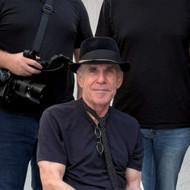
Douglas Dubler is a veteran American photographer whose career spans more than five decades, bridging editorial, commercial, and fine art disciplines. From his early training to the professional relationships sustained decades later, Dubler’s career is intertwined with some of the most prestigious artists, photographers and brands of the last century. Over the years he has maintained photo studios in St. Thomas, San Juan, Puerto Rico, Caracas, Venezuela, Rio de Janeiro, Los Angeles, and finally New York. He is widely renowned for his fashion and beauty photography, shooting for countless major magazines and cosmetic brands as well as iconic images of notable cultural and international figures from Mick Jagger, Elizabeth Taylor and Jane Fonda to Emirati Sheikhs.
His work is distinguished by a hard-earned technical mastery and a deep understanding of light and color that culminates in his achievements as a photographer, printmaking innovator, and educator.
How did you first get involved with Zeiss?
I have a decades long relationship with Zeiss. Going back more than 50 years ago, I had the great pleasure of meeting Victor Hasselblad. Then Hasselblad was the most famous camera company in the world, and they were partnered with Carl Zeiss. I met Victor when I was in my 20s, two years before he died when he flew me to Sweden and gave me a tour of the factory. One of the top executives from Zeiss also flew to Sweden to meet with me. In the meeting Victor Hasselblad said, “You can take any camera that you want.” The Zeiss exec said, “You can take any lens.” So, I picked two, and Victor Hasselblad even made me a special handmade leather case with a brass plaque with my name engraved on it. Only Zeiss was making the lenses for Hasselblad cameras then. I still have the case today.
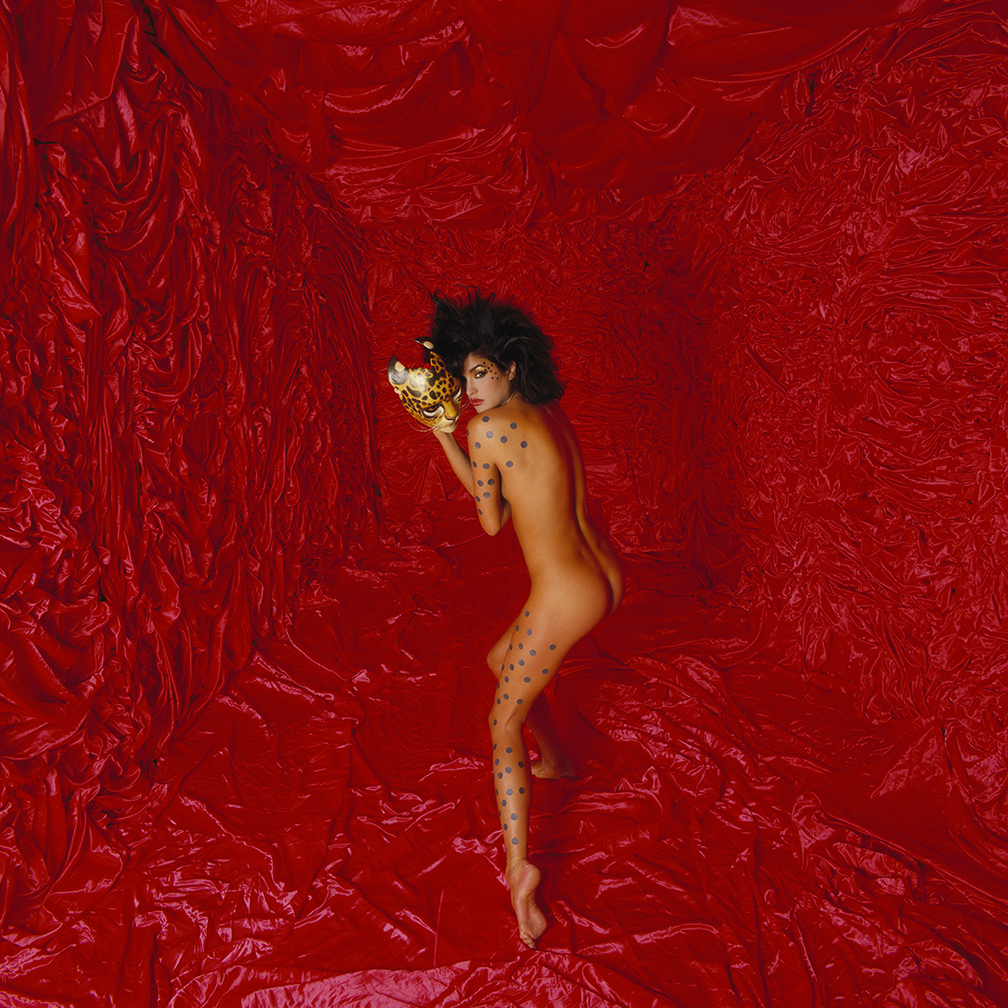
In 1985, I did a calendar with Zeiss and Hasselblad of the most famous models with Elite Model Management in New York City. Fuji gave me a quarter of a million dollars for the project. That was a lot of money for that time. (That’s about $3 million in today’s money.) Twelve models, 24 pictures, one beauty picture, one fashion picture for each month. I worked on the project for eight months. And only Zeiss lenses were used. The concept was to challenge the Fuji film with difficult situations, black on black, red on red, etc. The optical properties of the lenses were an extremely important component for this project.
I have a strong background in optical physics. On one of the subsequent projects I produced, Zeiss supplied me with a special lens for ultraviolet photography, made of quartz glass, not ordinary optical glass. One of the properties of quartz is that it has a high transmission of ultraviolet light. I pioneered the application of doing ultraviolet flash photography for fashion in the analog film days. It was very difficult. You couldn't take a light meter reading, the image didn't show up on a Polaroid, and you had to work in total darkness. Meticulous record keeping was required.
I had to put special, almost black, UV filters over the electronic flash heads secured with rubber gaskets. Those filters would get hot and explode, sending glass all over the place. I worked for three months in the total darkness, developing this technique to capture pictures with that special 105-millimeter quartz lens. There were only a few of them made and Zeiss loaned me the lens for a couple of years. We have always had a great relationship.
What was it like when you were starting out?
When I started out my career doing this, I was using a Nikon 35mm camera and Nikon lenses. I was looking at the pictures that Irving Penn, Richard Avedon and others were doing, and I saw that they were using Hasselblad cameras, a two and a quarter-inch camera, a very expensive camera, with very expensive lenses. I didn’t have much money and no rich parents. I did whatever I needed to do to make a living, including driving a taxi. But I wanted to level the playing field as far as the equipment was concerned.
That camera and the lenses were like $2,000, $3,000 in the '70s. That was a lot of money when you have limited resources. But then I got to meet Victor Hasselblad and got a leg up (in addition to the beautiful case). People did this stuff for me for one reason. Because I had passion, and that's contagious. When I speak to people, I impart some enthusiasm, some wisdom, and that comes with experience. I pay attention. Every day I go out of my building, I look around and observe what the light is doing. The light changes with the time of the year, with the azimuth of the sun. I know where the moon and sun set. These are just things I observe in my physical environment when I go out and walk around.
You studied and worked with some world-class photographers, including Ansel Adams and Irving Penn. Can you tell us about that?
Ansel Adams was in a class by himself. I worked with him when I was in my 20s. I studied with Ansel Adams and with Isamu Noguchi, the famous Japanese sculptor, and a very famous fashion photographer in New York City named Neal Barr. My philosophy was always to get educated by the people smarter and more talented than myself.
The thing about Irving Penn is that he did many different genres of photography. He did portrait, he did still life, he did abstract, he did fashion, he did beauty. He did each one of those things better than most photographers who just did one thing.
He was at the time making dye transfer and chemistry-based color prints. I was involved with Epson at the time, and I got them to give him one of their 24” large format printers. I advised on the set up of the printer and made several paper profiles for his favorite papers at the time. When people ask me what my color management qualifications are, I mention one name, Irving Penn. I don't need to say anything else.
I’ve always felt a quiet pride knowing that Irving Penn’s final two First Assistants initially worked with me–Billy Jim, and Vasilios Zatse, now Associate Director of The Irving Penn Foundation.
What is your background working with new lenses, like the Otus ML?
Tony Wisniewski sent me those lenses, and they're great. I have the original Otus lenses. I was very interested in seeing how this ML lens would compare to the originals, which are much heavier and more expensive. The 85mm is two pounds heavier than the ML lens. That's a lot of weight to carry around on the camera. The ML lenses compare quite favorably, the 85 especially. I shot the 85 Otus against the 85 ML. Zeiss and I found the differences in the images very difficult to discern. That’s saying a lot when you have such a high-quality reference standard.
The lenses are exceptional. The fact that that lens is manual focus, I don't have a problem with that at all. If I'm going to photograph something, I get the focus locked off, and then I keep my hands away from that ring, so I don't change the focus. I can change the f/stop, etc. But I'm absolutely sure of the focus. With these Zeiss lenses, there's a long throw for focusing. Compare that to a lot of other lenses which have a short distance, so you can't accurately focus.
To test a lens, you take the lens and focus it manually, take a picture, and then change the f/stop and focus it again. Sometimes when you compare, the focus is at different places between settings. That doesn't happen with the Zeiss lens.
I look at all lenses very critically. In my studio, I have a 17 by 22-inch printer. I make the equivalent of a 40 by 60-inch print, by grabbing a section out of the middle of an image. I shoot pictures with these lenses at all different f/stops then analyze them to decide what the best performance of the lens is.
You recently did a fashion shoot with Zeiss and the Otus ML lenses. How did it go?
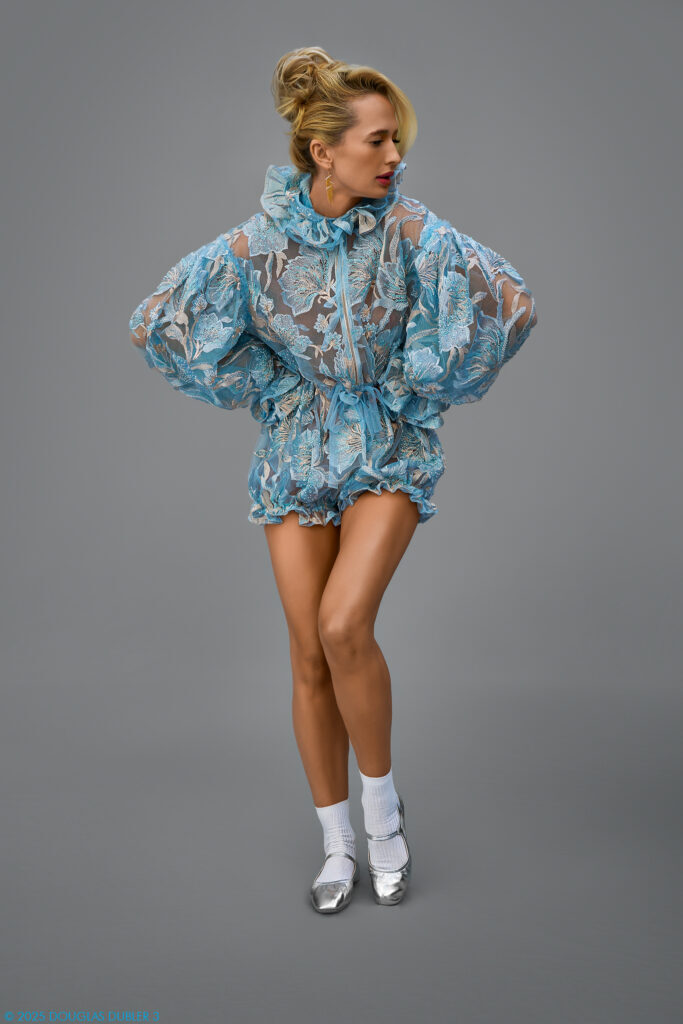
I did this fashion shoot with Zeiss and shot eleven shots in one day. I had 13 people working for me–it could have been a movie set. My digital tech was the studio manager for Irving Penn for 13 years, Billy Jim. He has been working with me for 43 years–he's one of the most capable people in New York City. He manages the digital tech, the capture and the lighting for me.
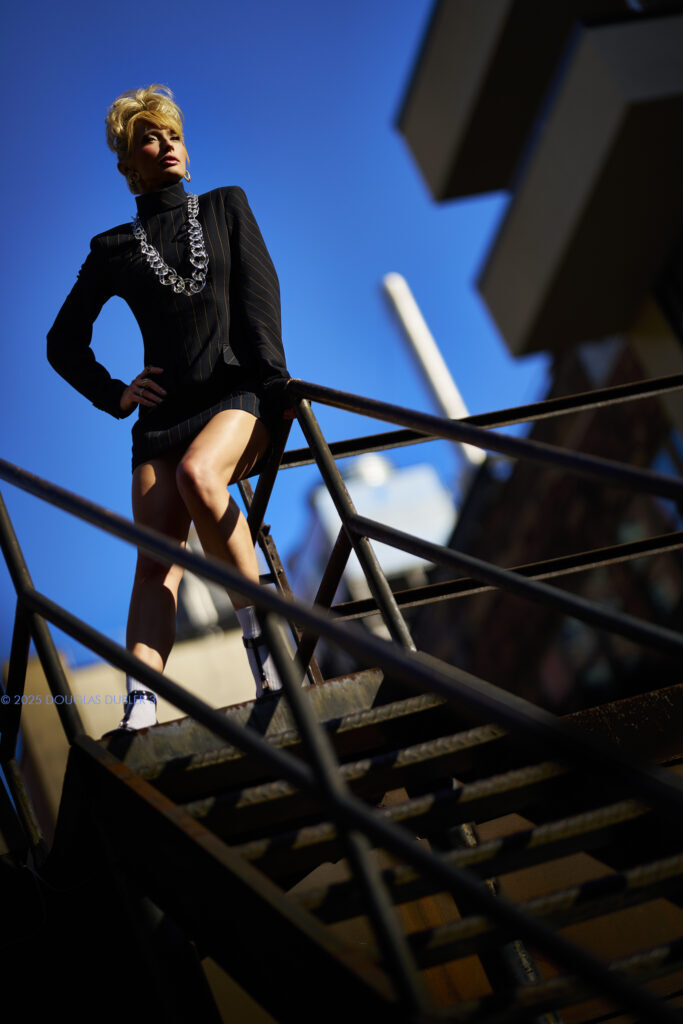
I'll send you the first picture that we did outdoors during the studio shoot for Zeiss. I was interested in the light outdoors, and I was watching that light all day long. I'm shooting pictures inside the studio, but every 15 minutes, I would go outside with my Sun Seeker app, waiting for the sun to go down behind some of these buildings and throw this stairway in the front of this building into shadow, but would leave the model in the sunlight. I want to shoot that picture at 1.4, which means I'm going to have the best boke and the background is very creamy, while the foreground is out of focus. If I stop the lens down, I have more depth of field, but I'm going to lose that boke.
(An aside from Douglas–It’s a Japanese term, right? It's B-O-K-E, not B-O-K-E-H. That's an Americanized spelling for it. The correct spelling is B-O-K-E. The Japanese have been obsessed with this for 45 years because that's the art of lens making.)
We didn't have much time to get the shot. I prepared everybody in the studio, the hair and makeup and the stylist. I had the 13 people working in the studio there, and Billy ran the whole thing outside there. I had 10 minutes of light, and I wanted to shoot two outfits on the model. The first picture that I shot is at 1.4 and it was the perfect picture. I shot another 90 something pictures, but that was the one that I used. You can see the background has a very creamy quality. You have to know this about the lens: if you stop the lens down, you lose that quality. I didn't want the background or the foreground to fight with the girl. At 1.4, but her face is razor, razor sharp because I'm very careful at focusing the lens, and then I don't touch it.
(For deeper analysis, see Douglas’ write up on the image ‘Nadia' on Facebook)
Anything else about the lenses?
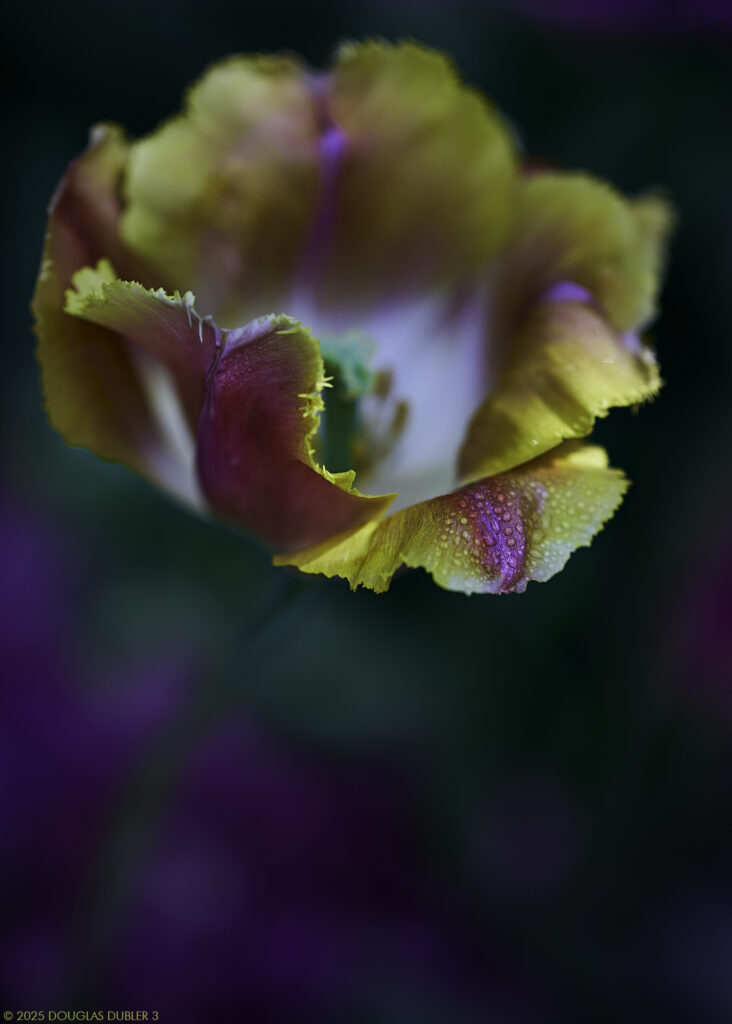
The 85 is a great lens. That's my favorite focal length lens. I have that lens on my camera all the time. When I can take that camera out and when I use it in APSC mode, it becomes a 135mm, giving me a quasi-macro lens. I have an 85 and a 135. The advantage of the Otus lens is that you can shoot with that lens wide open, and it's as sharp wide open as most lenses are when you stop them down. Now, the advantage to shooting with it wide open is the boke.
These Otus lenses are a synthesis of art and science. The science is the resolution. The art is the boke. You don't get this with any other lens.
Has the progression of digital photography changed how you take photos?
There's no difference. I use my brain. When I look at something, I know how I want the print to look. Then I work backwards through the technology. I'm using a digital camera right, but I used to use film. Film had seven t-stops of dynamic range. A digital camera has close to fifteen f/stops. To put it in perspective, when you shot transparency film–and if you were a professional, that's all you shot, you didn't shoot color negative film–then you had a latitude of maybe a half of a f/stop. With digital cameras you have a latitude of several f/stops. Really, I could teach my cat to take digital pictures, and I don't have a cat.
Ansel Adams coined something he called pre-visualization. You look at the scene that you're going to photograph, you imagine what you want the print to look like, and you work backwards through the methodology–the f/stop, the shutter speed, the ISO, the film, the processing. I call them your resources. When I get a new camera, I take the manual and I memorize the whole manual. It may take me six weeks to do it, but I don't want the operation of the camera in the front of my brain, I want it to be second nature, in the back of my brain.
Cameras have complicated menus, but lenses are very simple. When I get a lens, for example with the ML lenses, I take pictures at every f/stop, and I look at those pictures on the computer. I’m looking for resolution, depth-of-field, chromatic aberration, vignetting, and most important boke.
What is your preferred process for a fashion shoot?
When I did analog (film) photography in those years, it was typical for me to hire a test model, bring her on set, and do the shoot as a test the day before the actual shoot. That means that I'm giving up a day of my time. But when the art director comes in the next day, I'm showing him transparencies on the light box and the set is lit and ready to go. I would even pay a hair and makeup artist to do the hair and makeup, just with a different model. It might cost me several thousand dollars to do that, but I did that.
For every job that I did going back 45 years, I have written records about the technical information along with a diagram. What I say to people about art is, ‘It's not about talent. It's about repetition.’ Repetition is the key to success in any art. It's certainly the key to photography. In those analog days, I had to write of all that information down. Now, the metadata is recorded on the file when you shoot it. You have the f/stop, the shutter speed, the ISO–there’s no excuse not to pay attention to that information.
The thing that stands in the way of a lot of people is they aren’t thoroughly familiar with their camera. It takes some knowledge, some understanding and above all, time. You have to know what the relationship between f/stop and shutter speed is. It's either half the amount of light or double the amount of light. What is the best f/stop on the Otus ML? (I shot pictures at all the f/stops, and I determined that f-4 for the 50mm f1.4 ML was the sharpest aperture.)
You are described as a world class digital printmaker. What does that entail?
I had the good fortune to work in the darkroom with Ansel making silver gelatin prints. He said to me, ‘Douglas, if you have a legacy in the world of photography, it will be in the form of a print.’ This was 50 years ago and he was absolutely right–the art of photography is making a print.
I’m considered to be an expert in color management. There's this company called X-Rite, and they have these color experts called Coloratti. There are 13 Coloratti Masters and I am in that group. I also helped Epson become the number one printer company for color printing in the United States and was one of the founders of the Epson Stylus Pro professional group.
I developed a workflow, for which I also have a 16-page document. Making good prints is a combination of science and art. In my career, my effort has been to marry left brain and right brain thinking. The end result, meaning the photograph, isn't weighted technically, and it's not weighted creatively. Printing is an art form, but you have to follow a certain methodology. The key to this whole thing is repetition. You follow the steps and you really look at the end results.
The print viewers I use are made by GTI (Graphic Technology Inc.). I've been involved with that company for 50 years. You make the print and you look at it on the viewer. If there's something wrong with the print, you go back to the raw file and reprocess the raw file. Don't go into Photoshop and do something in Photoshop. You have to reprocess the raw file because if you make the changes in Photoshop, you're throwing away data. You're making holes in the histogram. The digital file is zeros and ones. You can push zeros and ones around and nothing happens to them. But once you process that into a tiff, you lose that ability.
What is the Xposure International Photography Festival?
Last year, I was responsible for the color management for over 2,500 large format prints up to size 60” by 80” at Xposure (the Xposure International Photography Festival in Sharjah U.A.E.). It's the most prestigious display of photographic prints in the world. I helped set up the color management in 2018. You've never seen anything like this in your life. On the two occasions that I had galleries there; I have never seen a prints exhibition that comes close to Xposure.
When people come in and look at these prints their jaws drop open. You will never get that impression when you're showing a digital image on an iPad or, god forbid, an iPhone... When you look at a photograph on your iPhone or your iPad, it has exaggerated color and contrast and it’s not in the correct color space, it's sRGB. When you make a print, the print is ProPhoto. That is a much larger color space.
If monitors provide reduced color-reproduction, how do you prepare digital prints for the larger ProPhoto color space, when you can’t visibly reference it?
That's where experience comes in. I know what that picture is going to look like. I look at the LCD screen which is in comparatively very low resolution and color. But I know from experience, from having done this for so many years, what it's going to look like. I take a photo into the computer, and I look at it in Capture One. I place small “color readout” points at various parts of the image. By controlling the numbers, I am assured of the corresponding values in the print. Again, it’s a matter of “repetition”.
When you're looking at a monitor, the best that monitor can reproduce is one of three color spaces: sRGB, Adobe 1998, or ProPhoto. sRGB is tiny, imagine a 3-inch circle. Then Adobe 1998 might be an 18-inch diameter circle. Adobe 1998 is the best that you can see on your computer monitor. But for ProPhoto, which is what a print is, you can't stretch your arms wide enough to make that circle. If you want to show color, why wouldn't you show it in a print like that?
What matters in photography?
My favorite quote is: ‘It's easier to ask for forgiveness than permission.’ I don't ask for permission. I ask for forgiveness when I get caught doing something that might be considered wrong, which was quite often in my long career. If you want to be a successful photographer, that's what you have to do.
Breaking the rules always got me somewhere. I won photography prizes and everything. A picture of mine just won the best black and white still life photograph this year by Spider B&W awards. The story behind the picture was interesting. In Central Park in New York City there is a boathouse on the lake with a restaurant. They limit the access to that restaurant to diners. I'm walking around with my camera and I see the light. The most important thing about photography is the light. Light is the tool that you paint with. I saw some amazing light at the very end of the restaurant in a closed section. I snuck around the side, went back into the kitchen, came out through the kitchen door, I went to where the table was, and I started re-arranging the table.
I do things very, very fast because I know exactly how I want it. I made my composition the way I wanted and I took the pictures. Then the manager comes in, and I say, ‘Oh, I'm sorry. I didn't know.’ But that picture won the photography award. The light that I captured there was gone in less than 10 minutes…
Any final thoughts?
I use my Facebook page as an educational platform. I tell people, go back on my Facebook page for a year and a half and you'll have an education in photography. For me, at this point in my life, because I've been mentored and educated by the best people, the only thing to do is to pass that information along. That's why I'm encouraging Zeiss to do more educational work. I've got a 50-year history with Zeiss, and I want to keep doing great projects with Zeiss, things that make people go, ‘Wow, really?’
Check out Dubler on set with Zeiss : https://www.youtube.com/watch?v=LY63SjNkwxg
Dubler’s extensive photography breakdowns can be found on his Facebook and Instagram with more work displayed at douglasdubler3.com.
All images in this article are copyright Douglas Dubler, used with permission.